Case Highlights:
- The procedure was first performed in 2025, with the patient demonstrating sustained improvement in tongue function at one-year follow-up; two additional patients have since been treated, also with positive results.
- Intraoperative nerve monitoring enables selective division of nonfunctional hypoglossal fibers, allowing ansa cervicalis transfer while preserving intact motor function.
- The technique may offer a less invasive approach for treating tongue paralysis.
Specialists from NYU Langone Health are pioneering a novel tongue reinnervation procedure that uses the ansa cervicalis to restore function to the hypoglossal nerve.
The first patient underwent the procedure in early 2025 after developing unilateral tongue paralysis following treatment for a benign hypoglossal schwannoma. She had been offered several treatment options, including a traditional hemiglossectomy with flap reconstruction, but declined due to the morbidity and invasiveness.
“She didn’t want to have such a big operation,” says Umamaheswar Duvvuri, MD, PhD, the Mendik Foundation Professor of Otolaryngology and chair of the Department of Otolaryngology—Head and Neck Surgery at NYU Langone. “We decided to offer her something that had not been done before—reinnervating the hypoglossal nerve using the ansa cervicalis, a motor nerve supplying the strap muscles of the neck.”
“We decided to offer her something that had not been done before—reinnervating the hypoglossal nerve using the ansa cervicalis.”
Umamaheswar Duvvuri, MD, PhD
The patient experienced rapid improvement in tongue strength, speech, and swallowing shortly after surgery, with continued improvement at one-year follow-up. Two additional patients have since been treated with the novel approach, both with positive outcomes.
Mapping the Hypoglossal Nerve
The central challenge to the novel nerve transfer, Dr. Duvvuri explains, was to avoid creating a new disabling deficit while providing meaningful motor input to the denervated tongue.
“The question was whether we could map the hypoglossal nerve well enough to selectively divide only the damaged fibers—without disrupting intact functional fibers and risking further loss,” Dr. Duvvuri says. “We’ve now shown that this level of mapping is possible.”
“The question was whether we could map the hypoglossal nerve well enough to selectively divide only the damaged fibers. We’ve now shown that this level of mapping is possible.”
Umamaheswar Duvvuri, MD, PhD
Intraoperatively, the hypoglossal nerve was exposed and mapped using intraoperative nerve monitoring. Individual segments were stimulated from proximal to distal to differentiate functional from nonfunctional fibers, allowing the segment of nonfunctional hypoglossal fibers to be identified and divided. The ansa cervicalis was then transected and connected to the hypoglossal nerve to replace the nonfunctional segment.
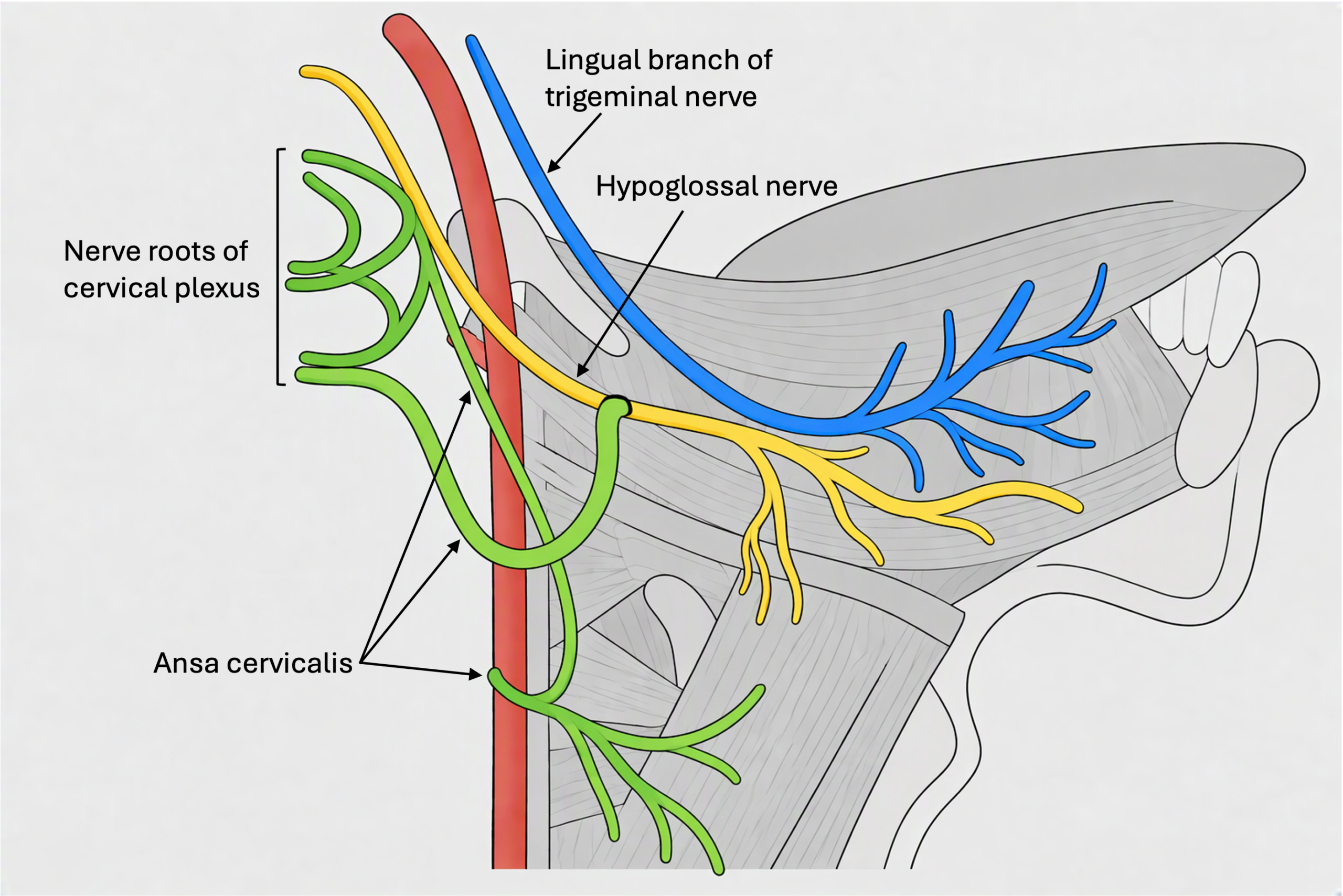
While the ansa cervicalis provides motor innervation to the infrahyoid muscles, it’s a preferred donor nerve for reinnervation as most patients experience minimal functional deficit following its harvest, reflecting the redundancy of the infrahyoid musculature.
The patient was hospitalized overnight and discharged on postoperative day one.
Functional Gains and Outlook
Because hypoglossal nerve reinnervation had not previously been performed, the degree and durability of functional recovery was uncertain. An additional challenge was that the patient had experienced tongue paralysis and atrophy for over a year. “The initial goal had been at least to stabilize function and prevent further atrophy,” Dr. Duvvuri says.
However, the patient reported early subjective improvement in tongue function shortly after surgery. “This was a surprise,” Dr. Duvvuri notes. “It’s possible that the dysfunctional fibers were exerting negative feedback on the muscle, and by removing those fibers, we may have released that ‘break’ and improved the function of the remaining fibers.”
“The observed functional gains exceeded expectations.”
Over approximately one year of follow-up, serial intraoral pressure measurements demonstrated objective improvement in tongue strength. Speech and swallowing function also significantly improved. “The observed functional gains exceeded expectations,” Dr. Duvvuri says. “By all accounts, objectively and subjectively, she’s improved.”
Based on early experience with this and subsequent patients, Dr. Duvvuri suggests that this strategy can produce meaningful functional improvement in select individuals. Future work is needed to define optimal timing, patient selection, and long-term outcomes, and to determine whether earlier intervention—prior to advanced muscle atrophy—can further improve outcomes.